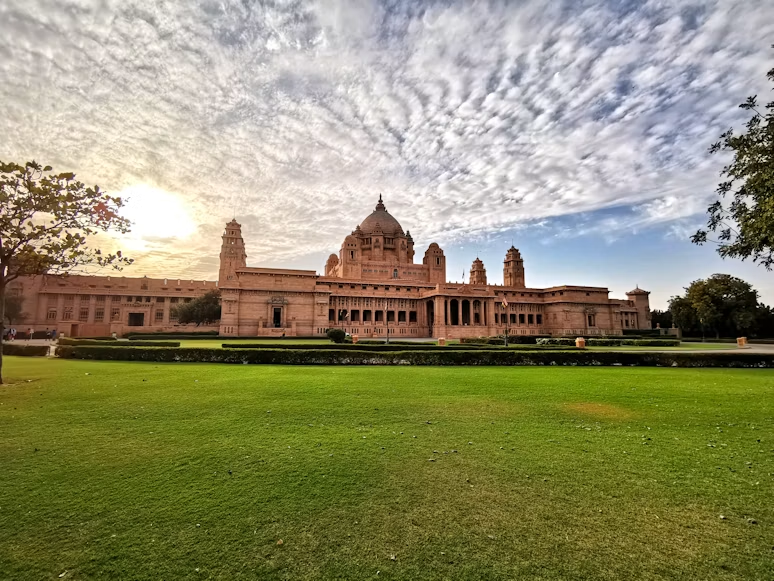
Mandawa is the part of Rajasthan most first-time visitors never hear about.
It sits in Shekhawati, a semi-desert region north of Jaipur where Marwari trading families grew rich
on the caravan routes in the 18th and 19th centuries and spent their fortunes covering their
mansions in paintings. Walls, ceilings, archways and even the undersides of balconies are frescoed
with gods and battles, elephants and courtesans, and later on with the merchants' new obsessions:
steam trains, motor cars, gramophones and aeroplanes. The whole region is often described as the
world's largest open-air art gallery, and Mandawa is its most rewarding single town.
This private 6-day tour puts Mandawa between Delhi and Jaipur, then
continues to Agra for the Taj Mahal before returning to Delhi. You get the three headline cities of
the Golden Triangle, plus a night in a small desert town where the streets are quiet, a caretaker
unlocks a haveli door for you, and dinner is likely to be served on a fort terrace.
Travel is in a private air-conditioned car with your own driver, and
licensed guides join you in each city.
Trip highlights
Walk through Mandawa's painted havelis with a local guide who reads the frescoes for you
Stay in a heritage haveli or fort hotel in Shekhawati
See merchant murals of aeroplanes, cars and Europeans painted by artists who had never seen
them
Take a camel-cart ride or an evening walk through the village lanes
Tour Amber Fort, the City Palace, Jantar Mantar and Hawa Mahal in Jaipur
Stop at Fatehpur Sikri, Akbar's abandoned sandstone capital, on the Jaipur–Agra road
Visit the Taj Mahal at sunset and again at sunrise
Explore Agra Fort, the emperors' walled palace on the Yamuna
Shop for block prints and blue pottery in Jaipur and marble inlay work in Agra
Travel privately throughout, with guides in every city
Day by day
Your 6-Day Itinerary
Jump to any day, or scroll through the full route below.
1
Day 1:
Arrive in Delhi
Your driver meets you at the airport and takes you to your hotel. Once you've rested,
your guide takes you out for the afternoon: Humayun's Tomb, whose garden plan set the
pattern for later Mughal architecture, the carved 12th-century tower of Qutub Minar, and
a drive past India Gate and the wide avenues of the colonial capital. If your flight was
long, we'll simply move the sightseeing.
Overnight in Delhi.
02
Day 2:
Delhi to Mandawa
After breakfast you head northwest into Rajasthan, a drive of about five to six hours
across increasingly dry, open country. You arrive in Mandawa by early afternoon and
check into your heritage hotel, often a converted haveli or a wing of the old fort.
In the late afternoon your local guide walks you through the town. You'll visit several
havelis, which may include the Hanuman Prasad Goenka, Murmuria, Gulab Rai Ladia and
Binsidhar Newatia houses, the last famous for its cheerfully inaccurate paintings of a
man in a hot-air balloon, a European woman in a car, and the Wright brothers' flight.
Many of these houses are still privately owned, and a caretaker will open the courtyard
for a small fee.
As the light softens, the ochre and indigo walls glow, which is when photographers do
their best work here.
Overnight in Mandawa.
3
Day 3:
Mandawa to Jaipur
You have the morning for more of Shekhawati: a camel-cart ride through the fields, a
walk past the town's chhatris and stepwells, or a short drive to Nawalgarh, where the
Poddar Haveli Museum holds some of the region's best-restored frescoes.
After lunch you drive to Jaipur, roughly three and a half to four hours. You arrive in
the late afternoon with time to walk through the old city's bazaars before dinner.
Overnight in Jaipur.
04
Day 4:
Jaipur
You start early at Amber Fort, on the ridge above Maota Lake, passing through the
painted Ganesh Pol to the courtyards and the mirrored Sheesh Mahal. On the way back you
stop at Jal Mahal, apparently floating on Man Sagar Lake.
In the walled city you tour the City Palace, part museum and part royal residence, and
Jantar Mantar, an 18th-century observatory of huge masonry instruments, then photograph
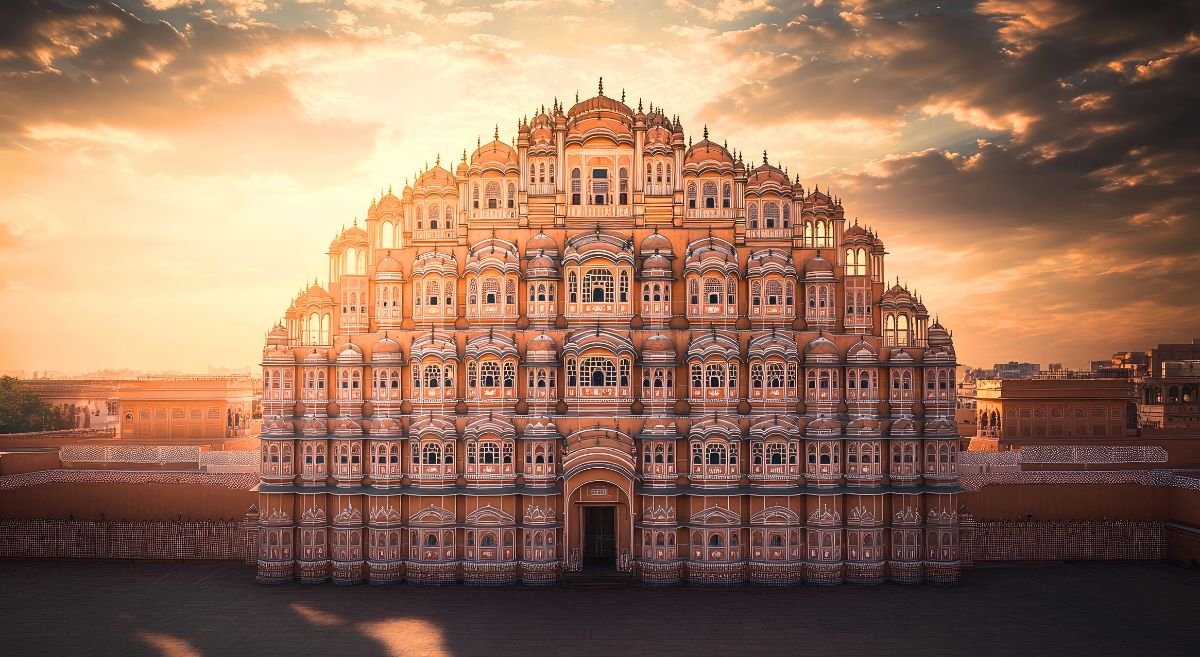
Hawa Mahal and its honeycomb of latticed windows. Your evening is free for Johari Bazaar
or a Rajasthani dinner.
Overnight in Jaipur.
5
Day 5:
Jaipur to Agra via Fatehpur Sikri
You leave after breakfast and stop at Chand Baori in Abhaneri, a 9th-century stepwell
whose thousands of steps fall away in a sharp geometric pattern, and then at Fatehpur
Sikri, Akbar's capital of the 1570s, abandoned within a generation and remarkably well
preserved.
You reach Agra in the afternoon. Your guide takes you to the Taj Mahal, completed around
1653 for Mumtaz Mahal, and then to Agra Fort, where Shah Jahan spent his final years
within sight of it.
Overnight in Agra.
06
Day 6:
Sunrise at the Taj and Return to Delhi
You return to the Taj Mahal as the gates open, when it is quiet and the marble turns from
grey to pink. After breakfast and check-out you drive back to Delhi on the Yamuna
Expressway, around three and a half hours, and your driver drops you at the airport,
railway station or hotel.
Included
5 nights' accommodation with daily breakfast, including a heritage hotel in Mandawa
Private air-conditioned vehicle with a professional driver for all six days
Fuel, tolls, parking, interstate taxes and driver allowance
All airport, hotel and station transfers
Licensed English-speaking guides in Delhi, Mandawa, Jaipur and Agra
Bottled water in the vehicle
All applicable taxes and 24/7 support
Included
Monument entry tickets, which can be added on request
Haveli entry fees and caretaker charges in Mandawa
In the Shekhawati region of Rajasthan, in Jhunjhunu district, about 260 km from Delhi and 170
km from Jaipur. It sits neatly between the two.
The painted havelis, and the fact that almost nobody rushes there. Seeing them in the
afternoon and again in the early morning light is a different experience from a quick stop,
and the heritage hotels are a highlight in themselves.
Large courtyard mansions built by merchant families. In Shekhawati their walls were covered
in frescoes, partly as devotion, partly as a display of wealth and worldliness.
No. Some are museums, some are hotels, and many are still privately owned or lie empty.
Caretakers usually open the courtyards for a small payment, which your guide handles.
It covers Mandawa well. If the frescoes really interest you, add a night and include
Nawalgarh, Fatehpur and Dundlod.
October to March. Shekhawati is desert country, so days are warm and nights can be genuinely
cold in December and January. April to June gets very hot.
Mostly converted havelis and fort properties, from simple heritage guesthouses to
comfortable boutique hotels. Modern chain hotels aren't really a thing there, which is part
of the appeal.
Yes. Delhi → Agra → Jaipur → Mandawa → Delhi works equally well, and we can adjust to your
flight times.
Yes. Mandawa involves a fair bit of walking on uneven lanes, but distances are short and the
pace is relaxed.